Rio. Hot, steamy, crowds and costumes. Carnaval is in the air, on the streets,-you hear and smell and see and it all makes for a sensory spectacle. The cariocas (locals) are open and friendly, expressing with their words and movement at all times. Carnaval is the biggest party going on right now-there are blocos of musical troups parading through the streets of all Rio´s neighborhoods. All you have to do is join. The costumes are inventive; sparkly and colorful-you see Superman, Snow White, fairies (of both sexes), the Flintstones, top hats, wigs, and masks, all walking down the same street. You eat pao con ceixo, and get frozen acai served up for an energy boost.
The beaches are teeming and the ocean is speckled with bodies riding the waves. The sand is beatifully coral in color and gleams in the sun. In the distance you see the famous view of the Sugar Loaf and the favela creeping up the hillside. It´s beautiful and intense, friendly and agressive, hot weather in a cool place.
There´s nothing quite like it.
lunes, 11 de febrero de 2013

jueves, 7 de febrero de 2013
Iguazu/çu Falls: Brazil vs. Argentina
Yup, still here in Foz de Iguaçu, Brasil-in a few short hours we´ll be hoping on a 16 hour bus back to Sao Paolo, ouch. On the 4th we went to Iguaçu Falls on the Brazilian side. We paid (a bit too much) to go onto a pontoon boat that took us up the Iguaçu River for a close and wet look at the falls. It was spectacular from this vantage point, and that was only the beginning. After getting drenched and hoping our zip-lock bag holding our cameras didn´t leak, we began the walking course of views along the Brazilian edge of the Falls. It is huge. You see smaller waterfalls with giant neighbors, most dropping at least 250 feet, the roar is constant as you explore this area. The finale, at the end of the path is a cat walk that juts out into the river and brings you right to the edge with views over to Argentina and the famous Garganta del Diablo (Devil´s Throat) drop, which is the highest at 269 ft (check the wiki link http://en.wikipedia.org/wiki/Iguazu_Falls) for an even better description.
Two days later I went alone to the Argentinian side of the falls (my friend would have had to pay the entrance visa, just for one day in the country, I luckily have my German passport). The views here were different, and also spectacular. On the Argentinian side you are able to walk around the park further distances to see the various views of the falls. There are more possible angles here, and the grand finale, the Devil´s Throat view point is phenomenal. Here you are slightly above the drop point and can see up close the immense amount of water rushing over the edge. At first it gave me slight vertigo to have this view, and I felt a bit light headed as I peered over the guard rail. At this spot you are getting quite wet from the spray.
I always find it worthwhile to visit these natural wonders of the world, but it must be said that at the height of summer vacation (in S.A) there were throngs of people taking photos, kids screeching and the like. It can take away from the natural beauty of the place you are visiting. This feeling of crowds, heat and sun were more pronounced on the Argentinian side, despite the fact there were more paths to walk on-the Brazilian side was a bit more tranquil. On both however, there were people trying to feed the local (but wild) Quatis- which resemble racoons-and can be equally as vicious. Although you are surrounded by natural beauty you are also surrounded by fast food stops and gimmicky and expensive extra attractions. The paths you walk on are paved and fenced. That is the price of making a natural place an attraction-but yes, we want to see it, and hopefully it works to create appreciation of such natural wonders.
Next up: Sao Paolo and Rio de Janeiro-two of the Cidades Maravilhosas (Marvelous Cities) famous in Brazil. We will experience Carnival which officially begins on the 8th, and all the fun and color that has to offer. Stay tuned!
Two days later I went alone to the Argentinian side of the falls (my friend would have had to pay the entrance visa, just for one day in the country, I luckily have my German passport). The views here were different, and also spectacular. On the Argentinian side you are able to walk around the park further distances to see the various views of the falls. There are more possible angles here, and the grand finale, the Devil´s Throat view point is phenomenal. Here you are slightly above the drop point and can see up close the immense amount of water rushing over the edge. At first it gave me slight vertigo to have this view, and I felt a bit light headed as I peered over the guard rail. At this spot you are getting quite wet from the spray.
I always find it worthwhile to visit these natural wonders of the world, but it must be said that at the height of summer vacation (in S.A) there were throngs of people taking photos, kids screeching and the like. It can take away from the natural beauty of the place you are visiting. This feeling of crowds, heat and sun were more pronounced on the Argentinian side, despite the fact there were more paths to walk on-the Brazilian side was a bit more tranquil. On both however, there were people trying to feed the local (but wild) Quatis- which resemble racoons-and can be equally as vicious. Although you are surrounded by natural beauty you are also surrounded by fast food stops and gimmicky and expensive extra attractions. The paths you walk on are paved and fenced. That is the price of making a natural place an attraction-but yes, we want to see it, and hopefully it works to create appreciation of such natural wonders.
Next up: Sao Paolo and Rio de Janeiro-two of the Cidades Maravilhosas (Marvelous Cities) famous in Brazil. We will experience Carnival which officially begins on the 8th, and all the fun and color that has to offer. Stay tuned!
domingo, 3 de febrero de 2013
8 Months Later...Brazil
First, an apology for abandoning this blog. It happens. I hope to revisit some of my experiences in Peru in the future, to wrap up my experience with the Peace Corps and write about some of my travels before leaving the country. At this time, however, I am in Brazil and want to stick with the present.
Currently, I am in the city of Foz do Iguaçu, the gateway to Iguaçu Falls which it shares with Argentina. It is hot (summer here in the southern hemisphere) and tropical. Lush and green. I am traveling with Shay, a good friend from home (Eugene, Oregon), and so far our travels have gone smoothly.
My first impressions of Brazil have been many. The people are as varied and diverse as I had heard, with many European immigrants, and a mix of African and indigenous roots. The people have been overall friendly and helpful despite our botched attempts to speak Portuguese. Ah Portuguese, I just don´t speak it. My Spanish has been useful to be sure, but much I don´t understand, and just can´t say. I hope to learn more in this next month.
Our first stop was Curitiba, a city known for it´s excellent recycling and sanitation systems, efficient public transport, and green spaces. It lived up to all this as it appeared clean, easy to get around, and cosmopolitan. We saw some interesting sights, such as the Botanical Gardens and the Oscar Niemeyer museum, which holds the largest collection of Brazlian art.
Brazil is huge, the 5th largest economy in the world, and it shows. In just a few days we have already taken one 6 hour bus, and a 10 hour overnight to get to Foz, and we have only crossed one state line. Especially when it comes to buses I can´t help but to compare Brazil to Peru. At this moment I can say that while they compare in comfort (good seats that recline, leg space, etc), Peru could learn from the peace and quiet on a Brazilian bus. No annoying movies featuring Van Damme or Stalone blasting while you try to sleep, not too hot, or too cold, and no meals at 11pm, that you don´t want anyway.
The Brazil we have thus seen is leaning towards overdeveloped with it´s deluxe mini-malls and gourmet coffee. The prices show too-it´s not cheap by any standards. But it definitely has it´s own flavor. The curvy language and curvy ladies, the flavorful foods and tropical fruits, and beautiful music which is becoming the soundtrack to our adventure. We are definitely in Latin America (or whatever you decide Brazil is, Latin? Portuguese?) Perhaps, to borrow from the film title, it is its own `Sexy Beast.`
Currently, I am in the city of Foz do Iguaçu, the gateway to Iguaçu Falls which it shares with Argentina. It is hot (summer here in the southern hemisphere) and tropical. Lush and green. I am traveling with Shay, a good friend from home (Eugene, Oregon), and so far our travels have gone smoothly.
My first impressions of Brazil have been many. The people are as varied and diverse as I had heard, with many European immigrants, and a mix of African and indigenous roots. The people have been overall friendly and helpful despite our botched attempts to speak Portuguese. Ah Portuguese, I just don´t speak it. My Spanish has been useful to be sure, but much I don´t understand, and just can´t say. I hope to learn more in this next month.
Our first stop was Curitiba, a city known for it´s excellent recycling and sanitation systems, efficient public transport, and green spaces. It lived up to all this as it appeared clean, easy to get around, and cosmopolitan. We saw some interesting sights, such as the Botanical Gardens and the Oscar Niemeyer museum, which holds the largest collection of Brazlian art.
Brazil is huge, the 5th largest economy in the world, and it shows. In just a few days we have already taken one 6 hour bus, and a 10 hour overnight to get to Foz, and we have only crossed one state line. Especially when it comes to buses I can´t help but to compare Brazil to Peru. At this moment I can say that while they compare in comfort (good seats that recline, leg space, etc), Peru could learn from the peace and quiet on a Brazilian bus. No annoying movies featuring Van Damme or Stalone blasting while you try to sleep, not too hot, or too cold, and no meals at 11pm, that you don´t want anyway.
The Brazil we have thus seen is leaning towards overdeveloped with it´s deluxe mini-malls and gourmet coffee. The prices show too-it´s not cheap by any standards. But it definitely has it´s own flavor. The curvy language and curvy ladies, the flavorful foods and tropical fruits, and beautiful music which is becoming the soundtrack to our adventure. We are definitely in Latin America (or whatever you decide Brazil is, Latin? Portuguese?) Perhaps, to borrow from the film title, it is its own `Sexy Beast.`
miércoles, 23 de mayo de 2012
Arequipa and Bolivia

Salar de Uyuni

Arequipa City
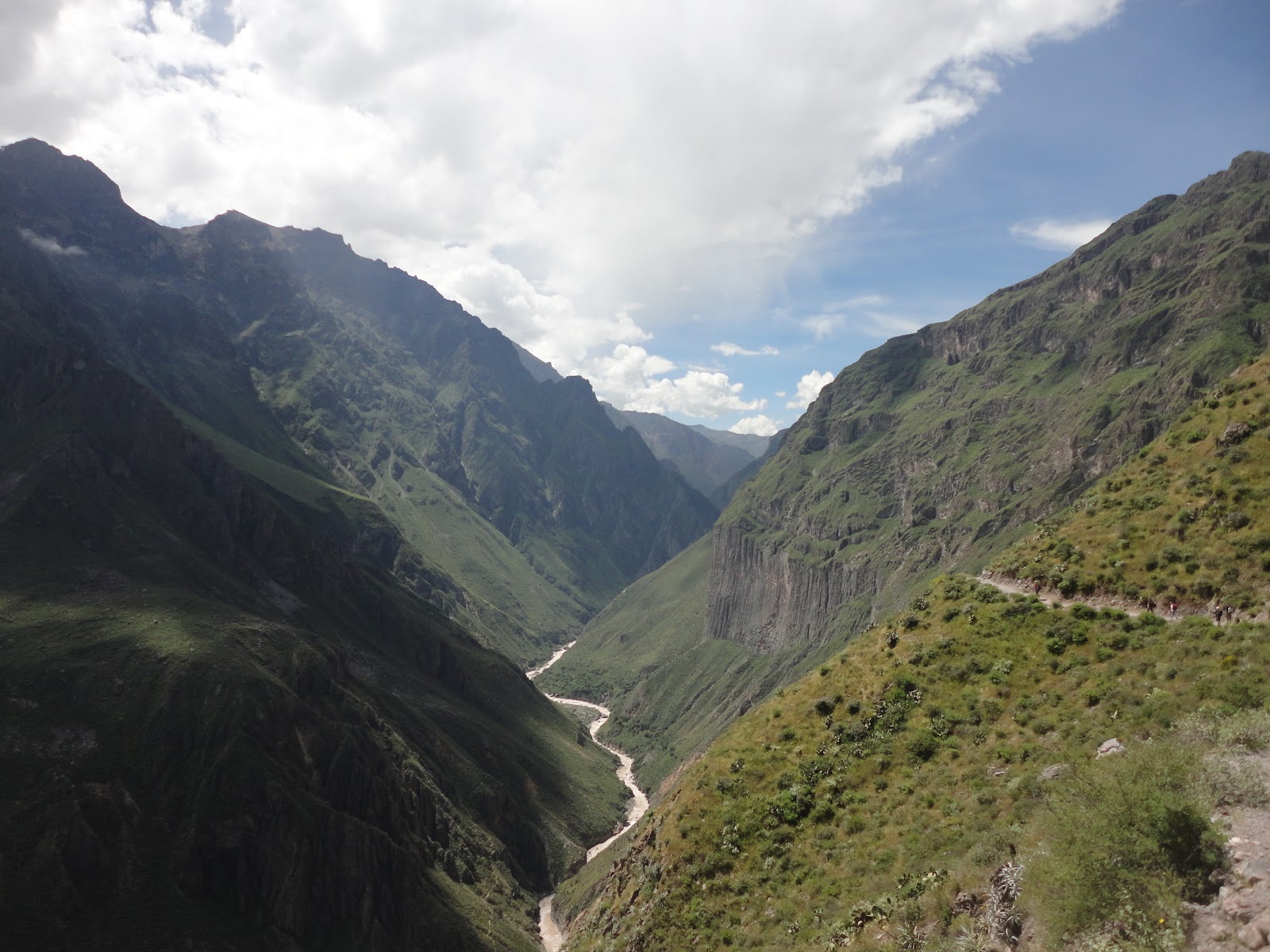
Colca Canyon, Arequipa

Church in Arequipa

One of the Lagunas Coloradas in the Altiplano of Bolivia

Ciudad de Piedras (Rock Forest), Bolivia
jueves, 26 de abril de 2012
Without Title
There are many new happenings to report. I have been neglectful as of late...however for good reason. I went to (what felt like) the end of the earth and back. It's called the Altiplano of Bolivia which borders Chile and Argentina. In order to get there I first took a night bus from Huaraz to Lima (7 hours). Then, the following evening took an another overnighter to Arequipa in the south of Peru (18 hours). Here, we watched the Semana Santa festivities and went on an amazing hike into the Colca Canyon, observing Condors in their natural habitat as well as Alpaca. From Arequipa we took another night bus to Puno on Lake Titicaca (the Peruvian side). Here, we descended into Bolivia, first with a bus that took us over the border to the funny named border town of Copacabana, a quick ferry across the lake, and another bus that took us to our destination of La Paz. La Paz is the highest capital city in the world at 3,800 meters. It is a very interesting place surrounded by mountains, but with a charm to it that is very unique. It's a large bustling city, sky scrapers and all, but surprisingly gentle.
From here, the real adventure began through the Altiplano of Bolivia. We decided to visit the salt flats in the south of the country. To get here we took yet another overnight bus to Uyuni. The ride is 12 hours normally, but due to the rains we got there in 15. On arrival we were met by a lovely woman who runs a tour operation with her husband. He was waiting with a Toyota Landcruiser Jeep to take us on an epic 980 kilometer excursion through breathtaking scenery at some amazing altitudes. Our first stop were the salt flats of Uyuni, which truly is a wonder. The expanse is over 10,000 sq. kilometers, and is estimated to contain over 10 billion tons of salt. Underneath the flats is a lake of brine which contains over 50% of the worlds lithium and is high in magnesium and potassium. In addition to the geological significance, and the big business of mineral extraction, this place is optimal for funny photos that play with perspective due to the surreal landscape and severe flatness.
From here we visited several fresh water lakes, witnessing Pink Flamingos and other bird species, surrounded by snow capped mountains and volcanoes. We stopped at a few rock forests which were formed when lava from volcanic explosions came into contact with glacial ice, forming spectacular spiraling formations. On our last day, tired, but still in awe we passed some geysers at over 5,000 meters and got to relax in some thermal baths with about 50 other tourists. Yes, this is a route hot on the gringo trail, however, I felt the experience was one of a kind. Our guide Christobal, an expert in the local geology, and a very good cook, was full of information and made us feel comfortable the whole way through.
I have never been in such an environment. Most of it is well above 4,000 meters and there is not a tree, let alone a plant in site. The sun is hot but the air frigid with sometimes strong winds. At our second camp we arrived to snow as a sunset pink lake sprawled out before us, pink flamingos feeding on the algae, mountains in the distance.
I think I'll stop there.
Next up, photos:)
P.S. Oh yeah, then I went all the way back to Peru.
From here, the real adventure began through the Altiplano of Bolivia. We decided to visit the salt flats in the south of the country. To get here we took yet another overnight bus to Uyuni. The ride is 12 hours normally, but due to the rains we got there in 15. On arrival we were met by a lovely woman who runs a tour operation with her husband. He was waiting with a Toyota Landcruiser Jeep to take us on an epic 980 kilometer excursion through breathtaking scenery at some amazing altitudes. Our first stop were the salt flats of Uyuni, which truly is a wonder. The expanse is over 10,000 sq. kilometers, and is estimated to contain over 10 billion tons of salt. Underneath the flats is a lake of brine which contains over 50% of the worlds lithium and is high in magnesium and potassium. In addition to the geological significance, and the big business of mineral extraction, this place is optimal for funny photos that play with perspective due to the surreal landscape and severe flatness.
From here we visited several fresh water lakes, witnessing Pink Flamingos and other bird species, surrounded by snow capped mountains and volcanoes. We stopped at a few rock forests which were formed when lava from volcanic explosions came into contact with glacial ice, forming spectacular spiraling formations. On our last day, tired, but still in awe we passed some geysers at over 5,000 meters and got to relax in some thermal baths with about 50 other tourists. Yes, this is a route hot on the gringo trail, however, I felt the experience was one of a kind. Our guide Christobal, an expert in the local geology, and a very good cook, was full of information and made us feel comfortable the whole way through.
I have never been in such an environment. Most of it is well above 4,000 meters and there is not a tree, let alone a plant in site. The sun is hot but the air frigid with sometimes strong winds. At our second camp we arrived to snow as a sunset pink lake sprawled out before us, pink flamingos feeding on the algae, mountains in the distance.
I think I'll stop there.
Next up, photos:)
P.S. Oh yeah, then I went all the way back to Peru.
martes, 20 de marzo de 2012
Born to Run
I kicked my own ass today. I needed to go run after a series of frustrating events. So I went out on a road that has large potholes/mud holes and a portion that is a steep hill. I ran down it, and up it, and down it, and up it...three times. Every time I was in the last 50 yards of that hill my lungs felt like they were going to explode (once again, we are at 12,000 ft). It really hurt, but it was also a release, and deep down I knew that these hill runs are slowly contributing to me becoming a bad-ass.
So what's so frustrating out here? The authorities don't respect me as a professional, for example, I don't get invited to participate in important community meetings, where other institutions are present, although I am representing an international agency. When I must frequently coordinate with a particular teacher at the school (all the high school teachers, and the director are men), I am immediately "linked up" with him, and the rumors begin. While the parents and kids are generally warm and friendly, there is little to no consistency in trying to sustain an ongoing activity. The culture here is reserved and the people will usually smile and say yes no matter what-they say what you want to hear-ok, I get this, but it also means that even when you really try to get out there, and invite people, most don't ever show. This is so much a part of our lives as PCV's that almost every one of us has some crazy story about bribing people to come, or telling them to show up three hours early, because then they may actually get there on time ("la hora Peruana" rules).
So these are my complaints. There have been accomplishments, yes, and the effort is always worth it. Just thank God that much of our work revolves around casual community life, chats, and playing with kids, because dealing with authorities get you some lip service of support and some sexual harassment at best, and trying to organize groups of people is just about one of the toughest things to take on-especially when the cultural divide is so wide. I commend Obama; and they say that being President is the toughest job you'll ever love.
domingo, 11 de marzo de 2012
More Recent-ish Pics

Making chocho (nutritious bean-type thing) during Quechua class

That's me, putting a condom on a banana (in front of 40 teenagers)

"Party combi" (aka our local transportation)

This is what a Peruvian pre-school graduation looks like (check out the miniature gowns and suits!)

Our latest success: Camp ALMA Verde, a camp lead and organized by volunteers in Ancash for teenage girls. This year we focused on environmental issues which included a fabulous creative finale fashion show using only recycled materials. Plus...an inspiring sexual health presentation by our awesome Peace Corps doctor.
The Devil and The Star
The title to this post refers to two cards I pulled up when recently getting my Tarot reading by a fellow PCV. Needless to say, getting The Devil was a little unnerving. However, the card came up in the slot for "the past," and was followed by the hyper positive, all evil erasing card, The Star in slot for "the present." Whew. Of course, we all have our inner demons and destructive behaviors that hold us back and bring us down, which is what The Devil card represents. The advice most generally given is to acknowledge this reality and come to peace with it. Try to ignore it and is gets a hold on you, give into it completely and you turn into Charlie Sheen.
Sometimes it just feels easier to throw in the towel in the face of frustration and disappointment. I relate this now to my ongoing work in the community. Things rarely turn out as you'd hope. You plan activities, invite people, and only a couple turn up, or the school last minute changes the hour of your activity, or it rains, etc, etc. But here you are, for TWO years, what can you do? You keep trying, you experiment, and try to move forward. In the last leg of this experience I look back to some of my "failed projects," and realize they weren't failures at all. I had thought of them as such because they didn't go as far as I had wanted, or we didn't do all my planned activities. But bottom line, we did something. I did work with teen girls on self-esteem and pregnancy prevention. My literacy group made visible progress, from being shy kids afraid to speak out to kids reading stories and performing puppet shows for their peers.
In the day to day as well, when we can acknowledge what it is that holds us back and make even the smallest steps to balance it out we can make change. Even if it's small, it counts.
domingo, 4 de marzo de 2012
Clouds Over Ancash
The usually blue skies over the cordillera blanca are not so blue these days. Ancash is Quechua for the color blue, a fitting name to a place with snow capped peaks and blue blue sky. The mountains, however can't ever be completely hidden, and they share their splendor through the fog and rain. It's true that winter, whether in the northern hemisphere or southern (here the rainy season is considered "winter" although it really is summer) is a time for reflection. More time indoors, cold weather, and the use of fuzzy socks get you thinking. There's a lot of pain and suffering in the world right now. What can we say to ourselves in order to stay grounded and positive? It's a tough question.
I think that we have an opportunity to look at ourselves in these tough times and really ask, what are we here for? What are we meant to contribute. With so much uncertainty I would say that it is not time to short change ourselves or mute our true calling. Inside each of us we have an intuitive voice that knows whether or not we are putting our energy in the right place, time to listen! For a young person this is a good time to figure out what makes me really happy. Better to start early than go through all that mid-life crisis chaos.
So, step by step, time to put aside what I "should" do, what's expected, and take some breaths to find that which makes me say, "yeah, this is me."
martes, 28 de febrero de 2012
These are the Times
Ok, so I probably won't be posting every day, but I'll shoot for "more often." This morning it is sunny and hot, already at 8:30am. This will be a difficult transition to deal with whenever I head back to the Northwest, or any northern country for that matter. I was sad to realize that I missed the showing of the 2012 Oscars, although the other unfortunate truth is that I had hardly heard of any of the films and actors nominated. While parts of Peru are certainly and open vein to all things global and new, that channel becomes increasingly narrow out in the mountains. Plus, as in the US, you have to be paying attention. Maybe I can watch it on Youtube...
I have, however just discovered the Huffington Post website. It's a god send! Great news in a very attractive format, at least for my eyes. With this I can follow the last fighting between Romney and Santorum, Michelle Obama's Oscar dress, and fun commentaries on all interesting subjects.
As far as work, today is a "jovenes hunting" day, meaning I'll be hitting the streets to get the interest of the young people in joining a health promoters group. Plus I get a visit from my friend Beth and her pup Gulliver.
Lots to look forward to.
domingo, 26 de febrero de 2012
The Daily Post
My new objective with this blog is to do a daily post (since I now have internet at my site), the goal being a short stream of consciousness, on whatever subject:
Post 1:
Cannot wait for February to be over. The shortest month has appeared to take the longest. Things are slow in the community, as summer vacation comes to an end. This last week we've had ceaseless rain. Rose for this month: going to the beach only 3 hours away, who new!
Thorn for this month: Getting Giardia.
miércoles, 15 de febrero de 2012
Redux: Books that I've Read Since Being in the Peace Corps
(I definitely forgot about a few the first round, so here's the updated version)
2) Once Segundos-Paulo Coehlo-288 Pages
3) Peony in Love-Lisa See-320 Pages
4) The Last Season-Eric Blehm-384 Pages
5) Light at the Edge of the World-Wade Davis-180 Pages
6) Zen and the Art of Motorcycle Maintenance-Robert Persig-373 Pages
7) The Bean Trees-Barbara Kingsolver-256 Pages
8) The Poisonwood Bible-Barbara Kingsolver-576 Pages
9) The No. 1 Ladies Detective Agency-Alexander McCall Smith-235 Pages
10) Tears of the Giraffe-Alexander McCall Smith-256 Pages
11) Fierce Invalids Home From Hot Climates-Tom Robbins-464 Pages
12) The Grapes of Wrath-John Steinbeck-473 Pages
13) When Things Fall Apart-Pema Codron-148 Pages
14) Shanghai Girls-Lisa See-336 Pages
15) The News from Paraguay-Lily Tuck-272 Pages
16) Three Cups of Tea-Greg Mortenson-368 Pages
17) Turn Right at Machu Picchu-Mark Adams-352 Pages
18) Born to Run-Christopher McDougall-304 Pages
19) Empire Falls-Richard Russo-483 Pages
20) A Walk in the Woods-Bill Bryson
21) He's Just Not That Into You-Greg Behrent & Liz Tuccilo-180 Pages
Currently Reading: Even Cowgirls Get the Blues-Tom Robbins
Total Number of Books: 21
Total number of Pages: 6,765
Favorite Book: The Bean Trees
Least Favorite: The News from Paraguay
Most Informative: He's Just Not That Into You
Most Inspiring: Born to Run
Best book to read while in the Peace Corps: The Grapes of Wrath (we got it good compared to the Jodes)
sábado, 31 de diciembre de 2011
NEW YEAR'S 2012
I am ready to ring in the New Year with a group of great new friends. After spending the holidays in the land of mustaches, aka Mexico with close and extended family, coming back to Peru felt like coming home. I am feeling excited to be in this country and to finish my service in Amashca-there are new prospects on the horizon. The coming of a New Year is always like the shedding of a skin, leaving behind the unnecessary and carrying forward the new lessons learned and the strength to put our growth into action.
At this point there are many unknowns, but I welcome them as I welcome the sunshine.
sábado, 17 de diciembre de 2011
La Chocolatada
This title refers to Peruvians favorite pastime during the holiday season: hot chocolate with paneton, a type of Christmas bread that comes in a box. In the mountains the weather has become rainy and the morning fog and evening clouds cover the snow capped peaks for most of the day, it's all very "North-Westy."
Many volunteers are traveling for the holidays visiting family and friends back home. I too, am fortunate to be traveling to Mexico for a visit to the familia. I look forward to seeing my grandmother and eating copious amounts of tortillas.
The last several weeks have proven to be fairly productive, with the close of the "Amigos y Libros" program with the local high school seniors in my school. For our finale, they put together a puppet theater production for the elementary aged kids. On December 21st they celebrate their graduation and release into the wide world. Some will continue their studies, some will stay and work the family land, others will head for the cities in search of work...usually in a factory of as a domestic. I'm proud of these kids.
Come New Years I will have about 7 months left of service, which will go by fast. These are the last 7 of the 27 total months. I will have many decision to make. Should I stay a 3rd year? If not, what next? Grad school, NGO work? Where to live? There are many uncertainties, and the situation in the US right now is somewhat scary economically. I think of all my friends back home and wonder how they are doing a midst all the unknowns that they also face.
Missing home is definitely a feature of the holiday time, so this goes out to all of you in Oregon, in Canada, in the Ukraine (I know someone out there is reading) and wish you a happy holiday season. I'll be ringing in the New Year back in the Peruvian Sierra and will send a big shout out from the mountain tops.
Elke
P.S. Papa, I made stollen again!
viernes, 25 de noviembre de 2011
Awesome Photos by Katie Halasz
Back in July the newest group of Youth volunteers cam to my site, Amashca for their "Field Based Training." One of those volunteers took these amazing photos. I hope you all enjoy!


miércoles, 23 de noviembre de 2011
What the @#$% am I doing here?
As many of you know, I have been living in the Peruvian Andes for about one year and three months, which leaves me nine months of service as a Peace Corps Volunteer. Thus far diary-like form of writing, and focusing more on what is going on around me, rather than what I am doing. In this blog I do hope to shed some light on what I have been doing here, as a volunteer both in work and in leisure.
So what the @#$% am I doing here? I have asked myself this question many times, and in various lights. But really, my job as a Youth Development volunteer has encompassed a range of activities. My goal is to work with youth and those who influence them; teachers, parents, health workers, etc. In my first year of work I had several short lived projects including a world map mural, “summer school” program, and a girl’s self-esteem group. Currently, I have been helping in the school with a project called “Amigos y Libros,” (Books and Friends) that meets twice a week. Created by another PCV, this project consists of a series of workshops in which high school kids learn to read stories to their younger elementary aged peers. They are taught how to project their voice, read clearly, use gestures and fun voices, and to ask the kids relevant questions. When the workshops are done the kids get into the classroom, usually two at a time to read to the youngsters. This has worked very well. The high school kids have greatly improved in their out-loud reading skills, and the little ones enjoy the stories and picture books. The teachers also learn that reading does not have to be boring and repetitive. Our finale for the year will be a puppet theater written by the older kids on topics such as hygiene and taking care of the environment.
Most recently, with the help of other volunteers, and the local health post I have finally begun the greatest challenge as of yet in my service: teaching sex-ed to rural Andean high schoolers, scary! We had a series of charlas the other week, and plan on using the upcoming World AIDS Day as a launching point to form a Youth Health Promoters group. These are kids that will be trained in all aspects of sexual and reproductive health, serving as leaders in their communities; because really, where do most kids get their information on sex? From each other of course! The health promoters will be a group of kids who have correct information, and this information will bleed out into the wider community.
Up next I will be planning another round of “Vacaciones Utiles” (utilitarian vacations, doesn’t have quite the same ring), which will meet twice a week in the hope to give the kids of Amashca fun and educational ways to spend their vacation time.
In my free time (believe me, there’s plenty of it) I enjoy hiking around the beautiful landscape, chatting with neighbors, yoga, cooking (and eating), the occasional art project, reading (I’ll be posting my reading shortly), and yes, I admit, a daily dose of TV (I have learned there are so many good shows out there!) This helps keep me sane and happy. I also talk with other volunteers, write in my journal, and dance huayno with my little host sister. All good stress relievers.
As a side note, I am looking for illustrated children’s books for grades 1-5. Preferably in Spanish (or Quechua if it’s out there), but if the text is simple they could be translated. You can contact me at elke765@yahoo.com


miércoles, 16 de noviembre de 2011
Part II: Epic Adventure
The Raft Race Continued:
Building a raft is much more difficult than you may think. First, you need to make sure it is going to float. The right sized logs are everything. Each team was given eight logs; this to be our “home” for the next three days. The whole process was a mad-grab for logs by each of the 48 teams; some fighting broke out, “that’s my log!” It got a little ugly. I for one knew nothing of raft building. A couple of Peruvian women approached us and offered to help us lash, nail, and get our raft together for the price of S. /100 (Soles). My three team members (all strapping young lads from Oregon) said nah, we can do it! So we tried, and tried, and three hours were still hacking out notches for the crossbars (on either end) with a dull machete, which instantly gives you blisters. While all this was going on, it was upwards of 95 degrees, humid as a bathhouse, and lunch was simply not arriving. We were all starting to lose it.
While the boys struggled with the machete, I tried to secure some rope for lashing. This was supposed to be provided for us by the organizers of the event, but there had been some problems, beginning with the fact that the president, a woman in her sixties, was in the town on the other side of the river, getting plastered. She had apparently given cash to an “assistant” to supply all the participants with rope, but this person (maybe seeing an opportunity?) never showed up, pocketing the cash. This little fiasco would set the tone for the rest of the event. Despite all this, our team of four kept plugging away. With the generous help of our neighbors (a team of locals who would end up winning the race), we got our raft notched up for the crossbars, found rope (also thanks to a generous team), and with much help, got our raft lashed together, and the legless chairs nailed down. By this time it was dark, and finally “lunch” arrived-alleviating some of the stress-then it began to rain.
Also thanks to the above mentioned negligence, drinking, etc. on the part of the organizers there weren’t enough tents for all the teams. We ended sleeping in a makeshift covering that originally had served as a shade structure. Others, were not so lucky, they ended up sleeping (or not) on their raft, good god. Thankfully, the day’s events (which had started with leaving Iquitos left us exhausted enough to catch some shut eye until dawn). Side note: dinner arrived at about midnight.
The next morning was the big day, all the teams launched into the water, ready for a long day of paddling. We got our raft in the water, at this exact moment realizing that it didn’t really float too well. The back right hand seat was basically submerged, but in the moment we didn’t think it would be too bad. They sounded the bullhorn and off we went! The minute I dipped my paddle in the water for the first push I knew this was going to be a trial and a half-the water felt heavy and thick as mud as it resisted against my paddle-I was sore after a few minutes. We paddled and paddled, even passing a few teams, and were feeling pretty optimistic despite our rafts defects. Then it started to rain. I was soaked through in about 5 minutes. About this time the currents started to convolute us, you can see them snaking through the enormous river sashaying this was and that. At one point we were dead center of the two banks, not moving at all. We crossed back over, heaving our half sunken raft that we had affectionately named “Zoolander,” because he had a hard time turning left. We were all tired, having paddled about five hours at this point; I had an emotional outburst at one point exclaiming, “We should have spent this money on a jungle tour!” (I told my team, “I am allowed one emotional breakdown per day”). Then we saw the docking point, thank God. We arrived, at about 3:30pm to a small jungle community named Nueva Esperanza. This was nice; to see what a tranquil Amazonian village is like, as it gets invaded by 300 foreigners.
The next morning our team, sleep deprived, sunburned, and mosquito bitten, and sitting in a sinking raft incapable of steering to the left, was not so eager beaver. But a wave of calm washed over us. We knew we had no chance to dominate this river, so we opted to go with the flow. Our strategy: stay to the left bank, paddle as little as possible. For most of the day this worked quite well. We had fun; we saw pink river dolphins, birds, and a crocodile. We ate oreos and shared funny stories. The sun was relentless, we got a little dehydrated, but overall we stayed positive. Our safety net was that we could get towed in by the coast guard be it that we didn’t make the next post.
The sun began to set, and a large dark cloud was building on the horizon. We had been on the water for ten hours, and really had no idea how much farther we had to go. We passed a man sitting on the side of the bank who said that we were still far away from the end. We started to get a little nervous, just then, we saw the coast guard boat, and in a final push we paddled to the boat. The main organizer, who had taken the place of the drunken lady, welcomed us on board. We lashed on the rafts and took off. Man we were happy to be off that raft! The sun started to go down, and a light rain started, thunder and lightning clapping in the distance-nature was now in full force. That’s when we found out there were still at least ten other rafts still on the water. What a disaster. By now it was dark, the river looming large and languid, its two banks separated by at least a half kilometer. Where were the boats? The rain was obscuring the spot light from the coast guard’s boat, the crew began to yell orders and a sense of urgency and fear fell over us.
The first team we spotted was stranded on the side of the bank, their camera flash going off and on frantically, their raft floating in the increasingly choppy water. Then there was another team, and another, our rafts were abandoned as the scared wet participants clamored on board. We made it to Tamshyaku, the medium sized town serving as our refuge for the evening. Tired, recovering from our scare, we ditched the refugee-style camp in the school gym to look for accommodations elsewhere. We met a man who offered us a small but dry room in his home for a very reasonable price. We took bucket baths and slept as soon as we hit the mattress.
This was the end of the race for us. Our raft abandoned, our arms and spirits exhausted, we rode on the crew’s boat back to Iquitos the next day, sipping beer and chatting with the rest of those who had to be rescued the night before.
We arrived to the last marker, watching the amazingly fast local teams come in first, nearly as quickly as we had on the boat. A man who had been taking photos for the event approached our team with a newspaper, “check this out,” he said. To our surprise, there we were on the cover of El Comercio, the most widely distributed newspaper in Peru. The last team, on the front page, ha! At least we survived.
 The Dense Jungle
 Raft building in Nauta
 The Team
miércoles, 19 de octubre de 2011
15 minutes on the Amazon
October 6-9 was the annual Great River Amazon Raft Race, held now for 13 consecutive years, the race is the longest of its kind. The beginning post is Nauta and the course traverses 180 kilometers to Iquitos, the largest city in the Amazon jungle of Peru (and notably the largest city on earth that cannot be accessed by road). There were a total of 46 teams, each with 4 participants, from across the globe. To describe this experience the word ordeal must be used. Arriving in the jungle, the first adjustment is heat, humid, tepid heat. Then, in the city, are the "mototaxis," as cars are not popular (lacking roads and all) the zooming mototaxis are everywhere. Going out into the jungle one hears an assortment of sounds: birds, insects, monkeys, everything is alive.
Here is my version of the events:
In preparation we had to secure the goods necessary for this event, the most important being lightweight paddles (they supply you will newly cut, but heavy paddles, not conducive for three days on the river). My team and I ended up in the markets of Belen, the floating city, and much behind in development and safety than the rest of town. Here, open sewers and outdoor barbershops line the streets. We made a friend who attached himself to us, somehow knowing exactly what we were there for. He took us across the river (my teammates named this "Rapeville"), to talk to a guy who "knows about paddles." Here we entered the mysterious paddle underground. We ended up meeting a very nice family, who supplied us with four suitable paddles of various sizes (our safety was never in question). The advantage to buying a used paddle is that a)this is what the people of the area use everyday, and b) they are properly "dried out" from use, and therefore lighter. After this, our new friend took us to "El Chino" for some plastic chairs (no one sits on wood logs for three days straight). Luckily, "El Chino," a good looking Chinese born immigrant with awesome tattoos, sold us the chairs at a reasonable price, and (to the amusement of his workers) cut the legs off for us...who needs legs on a raft? After buying some snacks, such as Oreos and "Granola Economica," we were ready for take off.
Day 1) We all met in the Plaza 28 de Julio in Iquitos, took a bus to Nauta (about 2 hours), to a welcoming ceremony held by the local municipality. Picture 200 gringos in a tent that also doubles as a microwave. From here they took us across the Maranon (the headwaters for the Amazon) to a mudflat area to build the rafts.
I know I am just getting started, but I am reaching the limit for anyone' s attention span, including my own, therefore...to be continued. But here's a link to keep your interest:
domingo, 11 de septiembre de 2011
Photos: Santa Cruz Trek


sábado, 27 de agosto de 2011
Face to Face
There are times when the last thing you want to do is deal with conflict, with negative feelings, with hurt and pain. Being as it is, the world is conflicted, hurting, being torn to pieces; what can we do? Each of us is capable of kindness, of compassion, and generosity, but often we feel so bogged down with our own concerns to find this place of peace within ourselves. Perhaps if we could let it sink in that this is really all we have to do, the world’s troubles wouldn’t seem so great. We can work, move through life’s events, both good and bad, confront issues, resolve problems, all the while maintaining a connection with our true selves. None of us are “useless” or adding to the problem as long as we maintain in our intentions this thread with our own and other’s humanity. Each of us can acknowledge that the path of life is the path to peace and that we don’t have to buck and revolt in order to find this.
We can create the spaciousness in our lives required, regardless of how busy we are. Taking time to acknowledge a moment, to observe, to take a breath; this can be done in any situation. There is a grumbling happening on a global scale; many things are not OK. Together, we can be with this unsettled, ungrounded world, and be not-OK together. As a human population we can relax into life with its shit and love and disease and healing. What a sigh of relief this could be, to allow the messed up nature of things, knowing that we are meant to be here, sitting with it all. This certainly isn’t a petition for apathy or laziness, quite the contrary; it takes a lot of work to be able to sit with all that we feel and experience, without judging it.
I recently read a book by Pema Chodron, a renowned Buddhist teacher from the US. This is my take on some of her teachings, and how I interpret them for myself and for a global movement for change. My favorite line of hers is one in which she says that we should “Give up Hope.” She says this in the context that we are all chasing something, a better personality, a better job, a different family. Just give it up and sit with it as it is, “hoping” for something better is potentially leading us on this destructive path. It’s very un-Obama, but I please ask you all to just Give up Hope.
Suscribirse a:
Entradas (Atom)
